Necromancy
The Calamitous BobNecromancy is a form of black-mana magic centered on controlling and enhancing undead. In the world’s military and ecological order, it is not merely a grisly method of spellcasting: it is the principle by which corpses become organized force, black mana sustains dead landscapes, and a single practitioner can turn scattered remains into a threat capable of destroying fortified settlements.
Definition and Magical Basis
Necromancy is associated primarily with black mana, the same broad magical affinity used by Viviane Saint-Lys. Its defining distinction is functional rather than elemental. Whereas Viviane projects black mana directly through destructive bolts and fields, a necromancer concentrates on making undead more effective and directing them in battle. The discipline therefore joins spellcraft to command: the dead are both the material of the magic and its military instrument.
The practice also demonstrates that black mana is not restricted to one immediate effect. Near Fort Sky, Viviane learns that a necromancer uses much the same mana type she does, but applies it toward the control and enhancement of undead. This establishes a dangerous parallel between her developing powers and the enemy’s art. Her affinity gives her a potential connection to the same magical domain without making her a necromancer; the difference lies in what the practitioner builds from that power and how it is employed.
Undead as Military Force
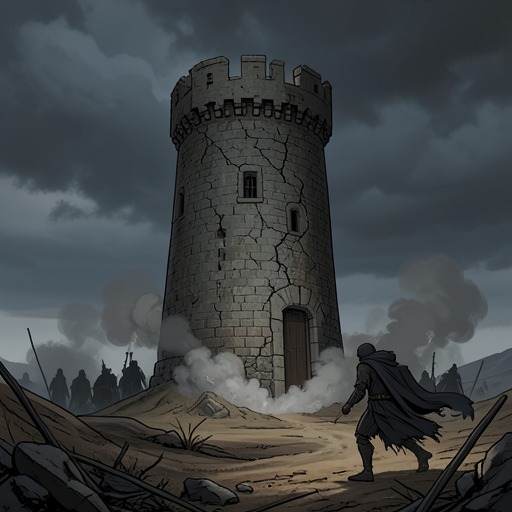
The necromancer’s army is composed of bodies arranged into a functional battlefield system rather than a random crowd. At Fort Sky, the approaching horde contains a central concentration of gut spillers, crawlers, and beasts. Fresher revenants form a surrounding ring, while gaunt, caped figures stand at regular intervals beyond them and a wider rabble of rotten bones and moaning flesh circles the formation. The horde moves with purpose, sheds slower specimens as it advances, and aims directly at the fortress.
This organization explains why the defenders treat necromancy as a strategic danger. A necromancer can use stronger undead to form protective layers around the controlling figure, allowing the practitioner to advance behind a moving wall of revenants. When the horde reaches the fortress, two gut spillers and two puppeteers protect the necromancer while making their way up the road. The necromancer remains only partly visible behind the mass, so the undead function simultaneously as weapons, armor, concealment, and a means of controlling distance.
The defenders’ own methods reveal how necromancy changes ordinary combat. The knights of Fort Sky use blades designed to smash into undead and push them back without becoming lodged in withered flesh; with sufficient strength, those weapons can cleave a target in two. Viviane continues draining individual revenants, while a mounted knight points out targets and judges whether they will enter interception range. Yet the undead detect the three knights from farther away than they detect Viviane, suggesting that the danger grows with the size of an expedition. A larger force may announce itself to the dead early enough to trigger a small zombie apocalypse.
Destruction and the Necromancer Threat
The arrival of the necromancer is reported to Viviane as part of a wider crisis: the nearest two forts have already been destroyed. The revelation changes the scale of the danger from isolated encounters with revenants to a campaign capable of erasing military positions. The necromancer is not simply another monster among the dead. The figure is an agent who can gather, improve, and deploy them against the institutions built to contain the Deadlands.
The battle at Fort Sky makes that threat visible in physical form. After the horde is defeated, Viviane sees a field of death stretching from the walls to the ramp, a solid mass of carbonized corpses forming a slope marked by bony protrusions. The fortress has survived, but the cost is severe: soldiers have suffered casualties, and five bodies lie beneath tarps in the courtyard. Necromancy thus produces consequences on both sides of the conflict. It weaponizes corpses, but its defeat also leaves the living surrounded by the material aftermath of a war fought through mass death.
The discipline’s destructive character is stated in stark philosophical terms. Mindless undead are presented as an antithesis to sapience: humans are fallible and fleshly, while undead are still fleshly and fallible but also stupid. A necromancer can build nothing and can only destroy. The claim places Necromancy opposite not only to ordinary life but to intelligence, craftsmanship, and durable civilization. Its apparent power depends on assembling bodies, yet its governing logic is depletion rather than creation.
Necromancy and the Deadlands
Necromancy is inseparable from the environmental condition of the Deadlands. The region receives no rain, has no renewable food source, and contains no surviving patches of grass. Its buildings offer shelter, but the surrounding land is otherwise dead. As Viviane approaches the mountain gap, the black mana density begins to fade and green forest becomes visible beyond the plains; the contrast makes the Deadlands’ lifelessness appear as a distinct magical ecology rather than ordinary desolation.
That ecology is self-reinforcing. The Deadlands have reached an equilibrium in which the enormous population of undead monsters creates a black field of its own. Killing enough of them to reduce that field would require several large-scale expeditions, and recovery would take decades. No kingdom is willing to spend such resources on land considered worthless when easier regions can be developed. Necromancy therefore persists not only because necromancers command undead, but because the undead collectively maintain the conditions in which more undead can continue to exist.
The surrounding world offers a deliberate counterimage. In the greener country beyond the mountain range, ordinary trees and grass return, and the living landscape becomes a form of salvation after the Deadlands. At Cassian Springs, the death of Cassia the Unbroken is remembered through the emergence of a spring whose waters still carry the blessing of Neriad. That sacred transformation gives death a generative afterlife, sharply contrasting with Necromancy’s use of death as material for control. One kind of death becomes water, memory, and protection; the other becomes an army that advances without sapience.
Narrative and Thematic Significance
Necromancy supplies the book’s clearest convergence of magic, military organization, and ecological collapse. It turns a magical affinity into a system of command, makes fortifications necessary, and explains why the Deadlands are not simply a place containing monsters but a region whose conditions reproduce the threat. The horde’s layered formation gives strategic shape to what might otherwise be an undifferentiated mass of undead.
The concept also tests Viviane’s position. She shares the necromancer’s association with black mana, yet her power is shown through movement, improvisation, and direct combat: after receiving training, she runs with exhilaration while sending dark-mana bolts to either side, no longer suffering the usual exhaustion and headache associated with strenuous casting. Her use of black mana remains distinct from the necromancer’s dead-centered discipline. The contrast prevents the magic from becoming a simple moral label; the same affinity can support different practices, and the decisive question is whether it is used to animate destruction or to survive and oppose it.
Ultimately, Necromancy represents a closed system of death. It gathers what has already fallen, strips away independent purpose, and directs the resulting mass toward further ruin. Its defeat at Fort Sky does not erase the system, because the Deadlands themselves continue to generate black mana through their undead population. Against that persistence, the story sets living growth, trained cooperation, sacred remembrance, and the possibility of crossing out of the dead zone into a world that is still green.